
Most enterprise agent projects do not fail on the model. They fail on the trust layer. Here is what that means.
A pattern is showing up in board-level AI reviews this year. The POC worked. The demo was convincing. The budget got approved. Then the agent tried to move from a sandbox with two users to production with two thousand, and something quietly went wrong.
The failure was rarely the model. Frontier models are performing well enough for most enterprise tasks. What breaks is the layer around the model. Who the agent is acting as. What tools are allowed to call. How its actions are logged. Who reviews its escalations. What happens when a payer, a partner, or a bad actor slips instructions into a document the agent is reading.
That layer has a name in enterprise architecture conversations now: the trust layer. In most organizations, nobody owned it during the POC. The CIO is being asked to own it now.
Traditional role-based access control assumes a human user with a session. The user logs in. Their role decides their permissions. Every action gets checked against those permissions in real time.
Agents break every part of that model.
An agent acts on behalf of a user but is not the user. When a customer service agent invokes a CRM tool to pull an account record, whose permissions govern the read? The end user asking the question? The service account the agent runs under? The team that deployed the agent?
In most POC deployments the answer is uncomfortable. The agent runs under a broad service account with far more access than the end user has. This works fine for the demo. It creates a serious problem the moment the agent is asked a question its user was never authorized to ask.
Then there is scope creep in tool permissions. Every new tool the agent gets access to widens its potential blast radius. Teams tend to grant permission at the tool level, not the operation level. The agent can read from the CRM. Fine. Can it also update? Delete? Export? By the time anyone audits, the answer is usually all four.
The security literature has a name for this: the confused deputy problem. An entity with more privilege than the caller is tricked into acting on the caller’s behalf in ways the caller could not have done directly. AI agents are confused deputies by default. Fixing that requires three things: identity delegation done properly, scoped tool permissions at the operation level, and per-invocation permission checks. Very few 2026 deployments have all three.
Most teams put guardrails in the system prompt. Do not answer questions about X. Do not disclose Y. Escalate Z to a human. Then they consider guardrails handled.
That approach fails in production for a simple reason. The system prompt is one input to a probabilistic system, not a hard control. A determined prompt injection, a legitimately ambiguous user question, or a tool response carrying hostile content can override it. Prompt-only guardrails are hopes, not controls.
Real guardrails live at three layers:
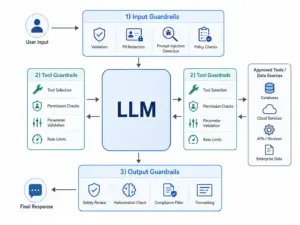
Any one layer, on its own, fails eventually. All three together create defense in depth.
The organizations shipping agents to production without incident are the ones that treat guardrails as an engineering discipline, not a prompt engineering exercise. They log every guardrail decision. They review the logs weekly. They retire guardrails that never fire and add new ones when a new failure mode shows up. That is what governance looks like day to day.
Prompt injection gets the coverage in the security press. It is a real problem, but in a well-designed enterprise deployment, it is not the biggest one.
Three larger risks keep showing up in production reviews.
The OWASP LLM Top 10 covers most of these categories in its current version. It is worth pinning a copy in your architecture review process and walking through each item against your deployment. This is a twenty-minute exercise that catches most of what real attackers will try in the first year.
Governance in agent deployments is not a document sitting on a Confluence page. It is a set of running controls in production. The ones that matter:
None of this is exotic. It is the same operational discipline enterprise IT applies to any production system. The problem is that AI teams often come from a research or data science background where this discipline is not the default, and enterprise IT teams often do not yet feel qualified to review AI systems. The gap between those two teams is where governance falls.
Before signing off on an agent deployment moving to production, three questions are worth asking:
If any of the three answers is unclear, the deployment is not ready. Not because the model is not good enough, but because the trust layer around it is not yet built.
The models are ready. The governance layer, in most organizations, is where the real work still is.
Input your search keywords and press Enter.